If you have a need to contact us, email us at [email protected] or use the form below.
We look forward to serving you!
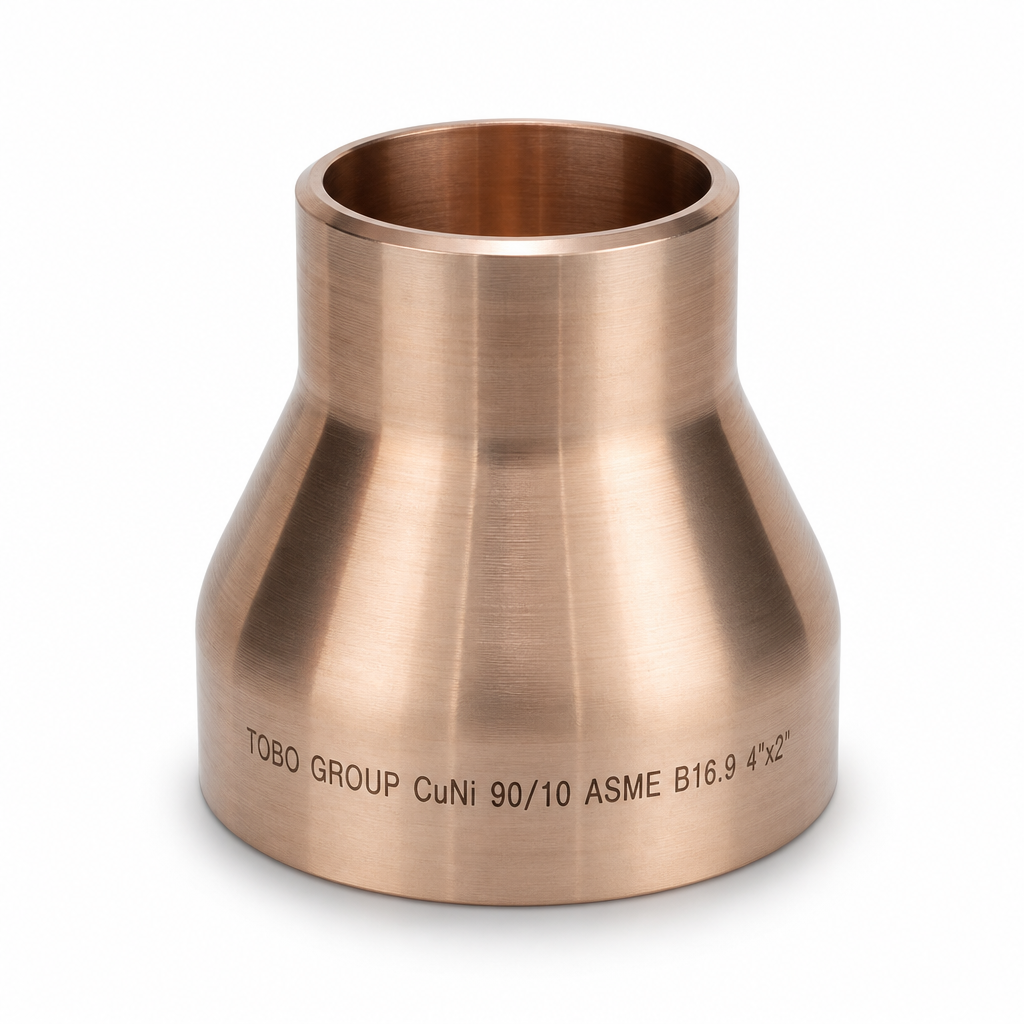
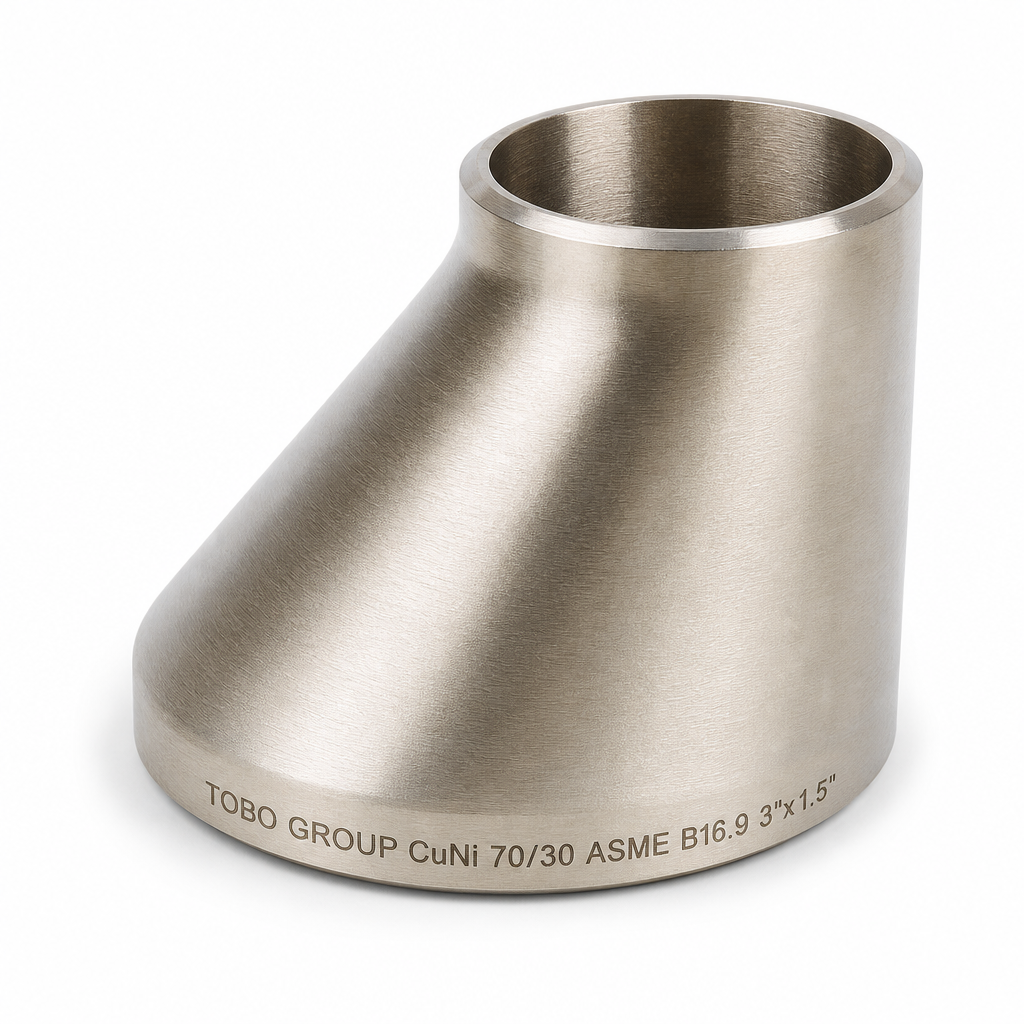
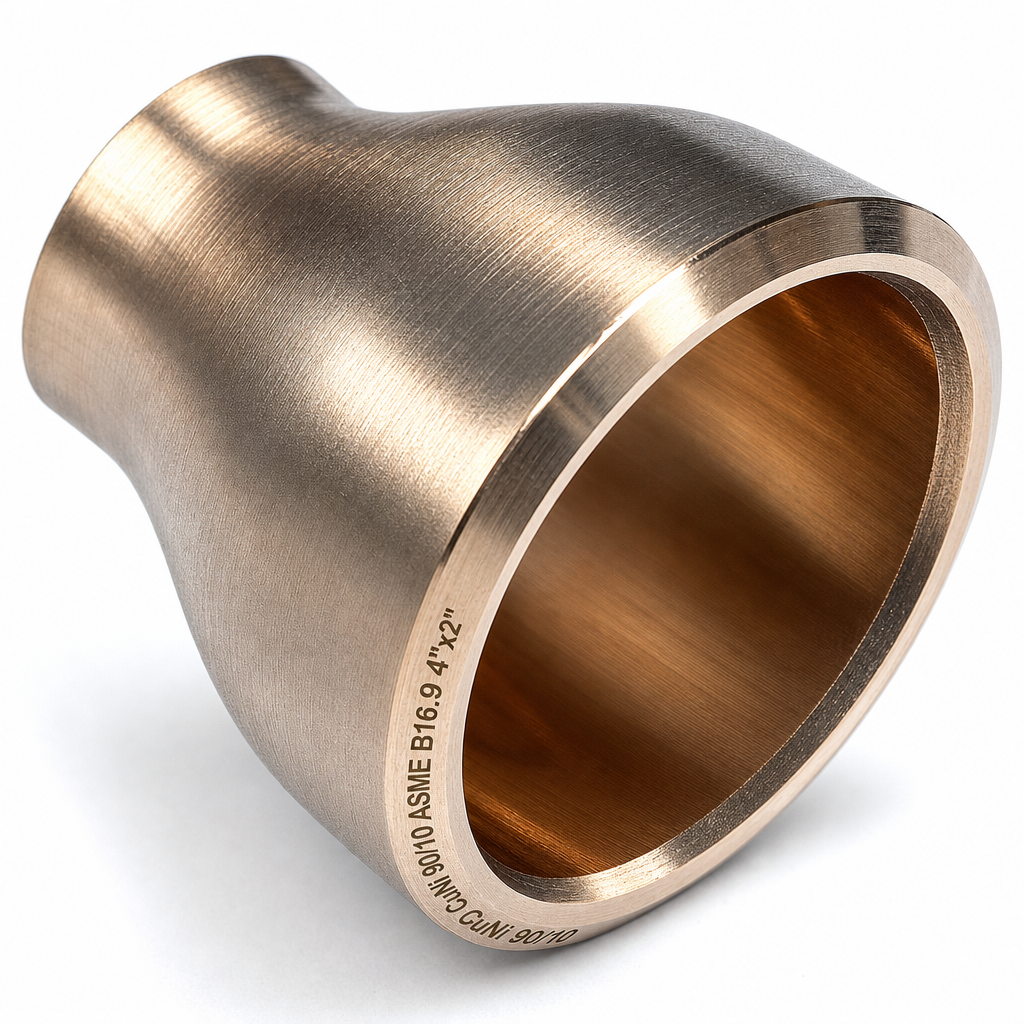
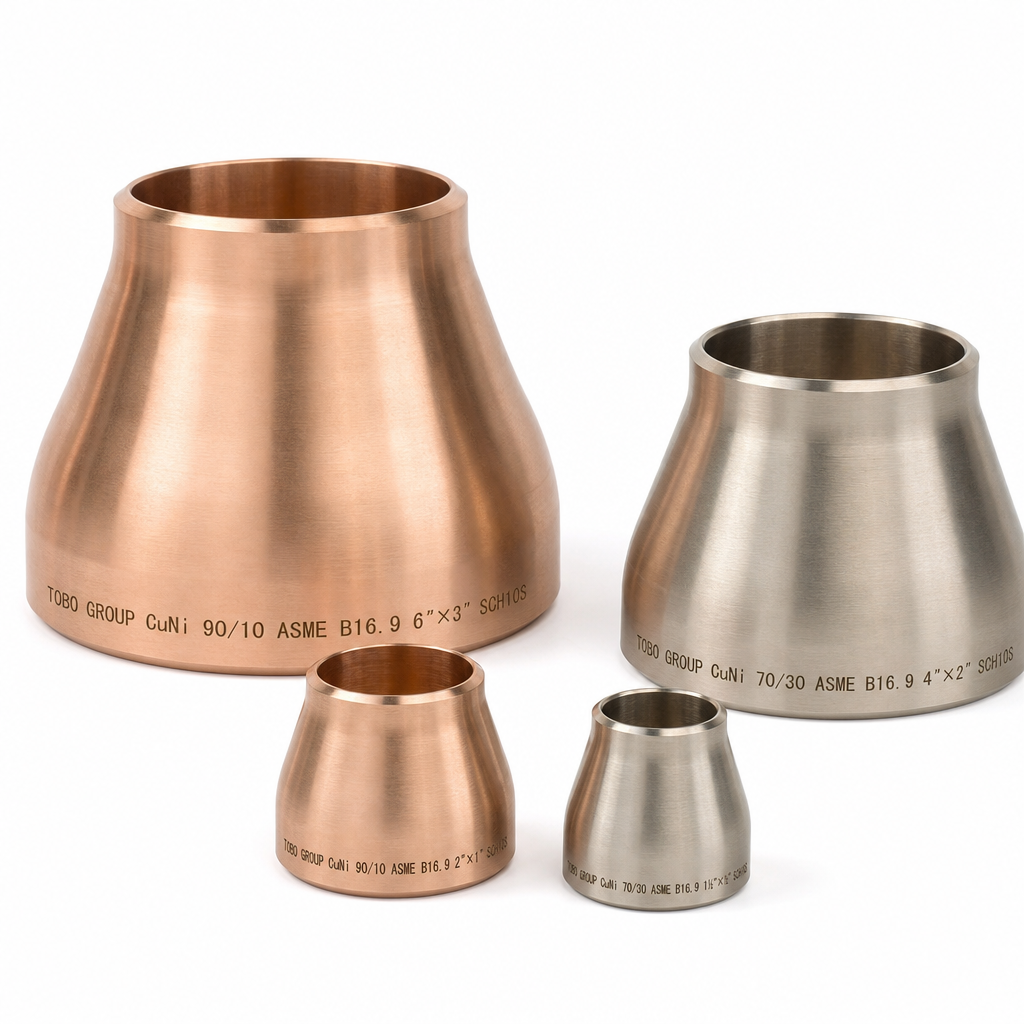
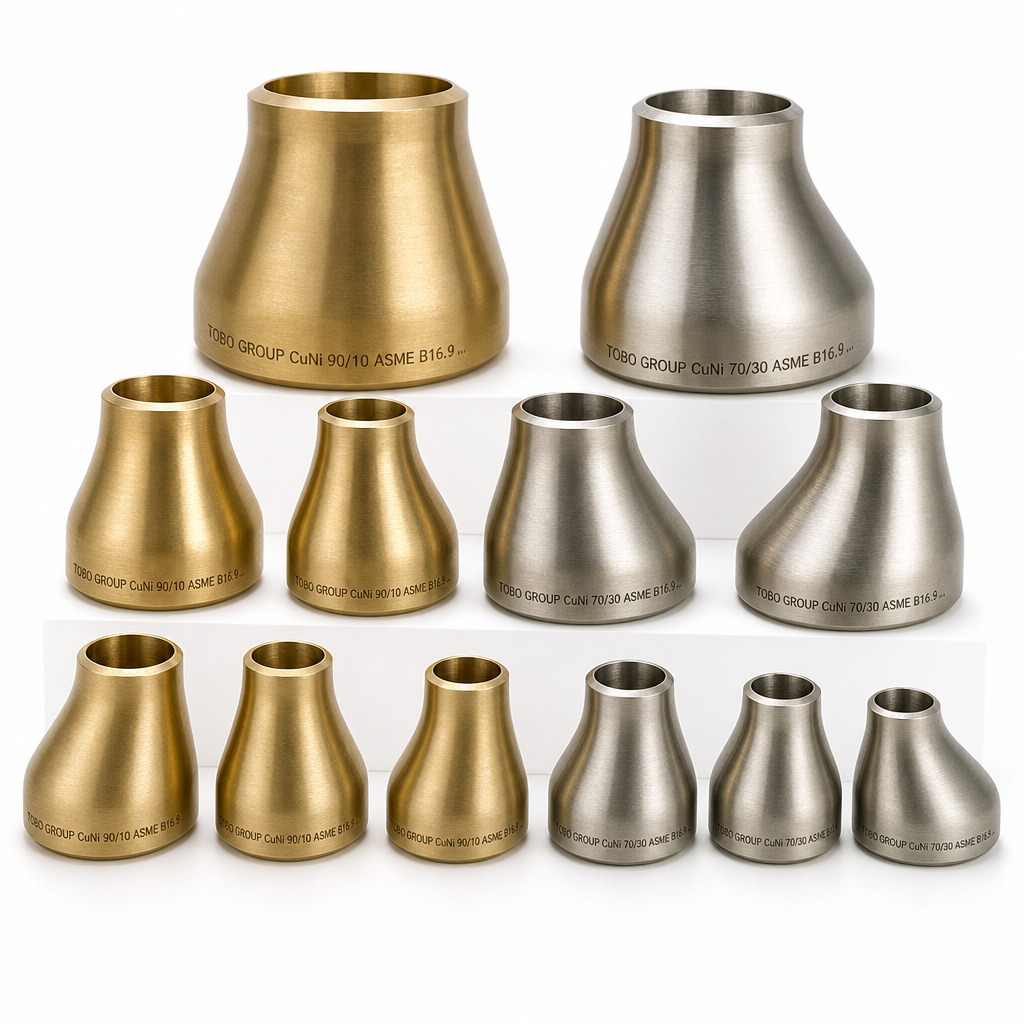
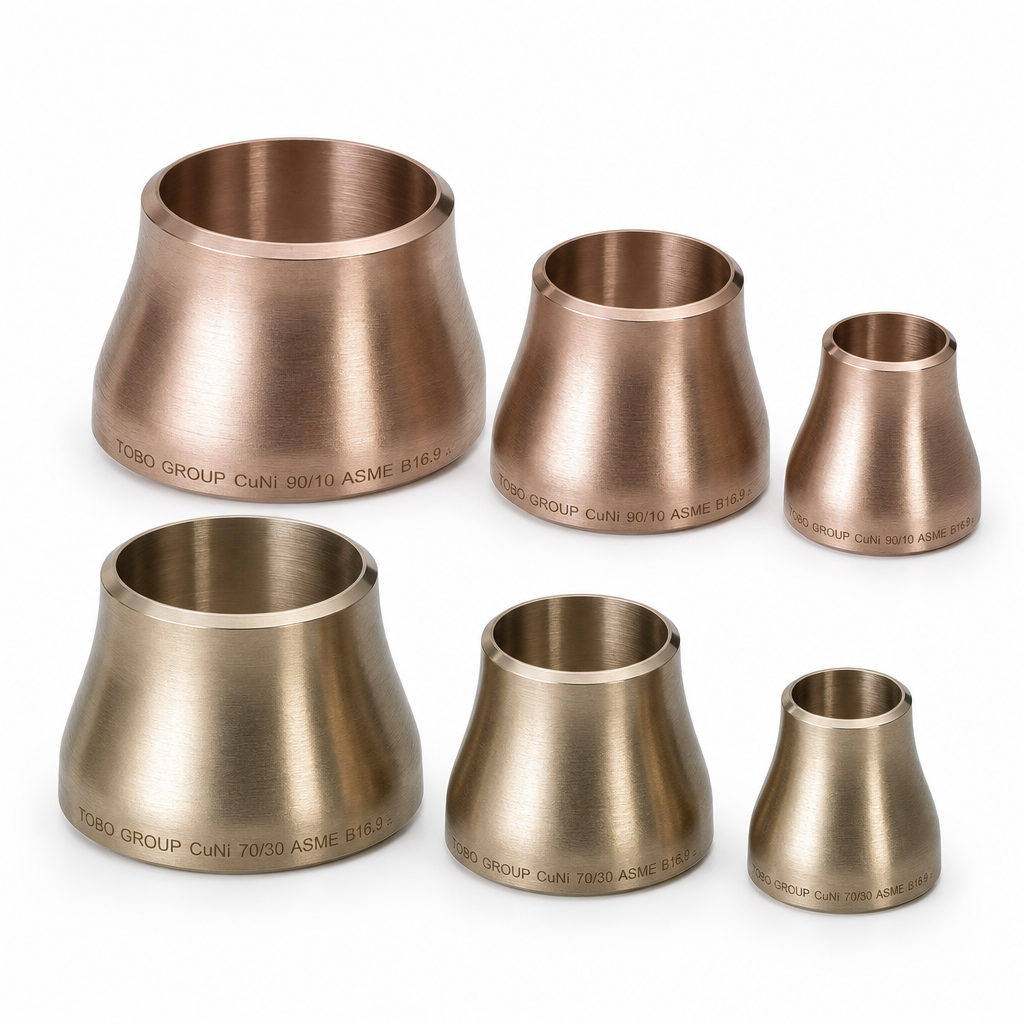
90/10 and 70/30 Copper-Nickel Alloy Pipe Reducers and Pressure-Reducing Valves
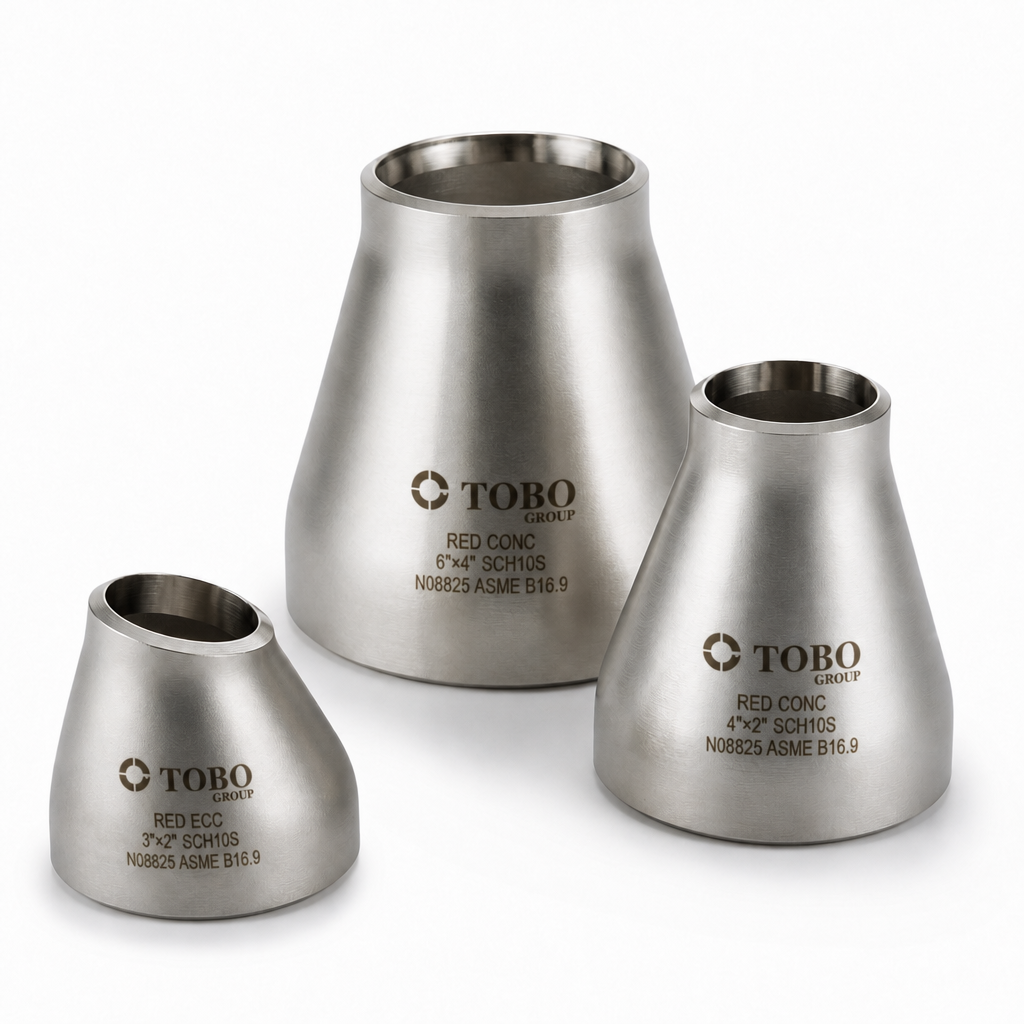
Copper-nickel alloy reducers (reducing fittings) are critical butt-weld fittings for changing pipe diameters in seawater and highly corrosive environments. They are available in 90/10 CuNi (C70600) and 70/30 CuNi (C71500) grades: The 90/10 grade balances corrosion resistance, strength, and life-cycle costs, making it suitable for conventional seawater cooling, ballast systems, and desalination; The 70/30 grade offers superior resistance to high-velocity seawater scouring corrosion and is suitable for high-flow-velocity points such as pump outlets, valve assemblies, and high-pressure seawater systems. The products are available in concentric and eccentric configurations, as well as seamless and welded structures, and comply with ASTM B366/ASME B16.9, EEMUA 146, and DIN 86089. Sizes range from DN15 to DN1200, with wall thicknesses from SCH 5S to SCH XXS. Their nickel-rich iron corrosion product film dynamically self-repairs to resist erosion corrosion in diameter transition zones, while also offering natural resistance to biofouling and copper-nickel butt-welding compatibility. These products are used in marine and offshore engineering, seawater desalination, power plants, and offshore oil and gas pipelines containing H₂S or chloride ions. On the product details page, you can select the appropriate model based on the 90/10 standard general-purpose guidelines or the 70/30 guidelines for high-velocity, severe operating conditions.
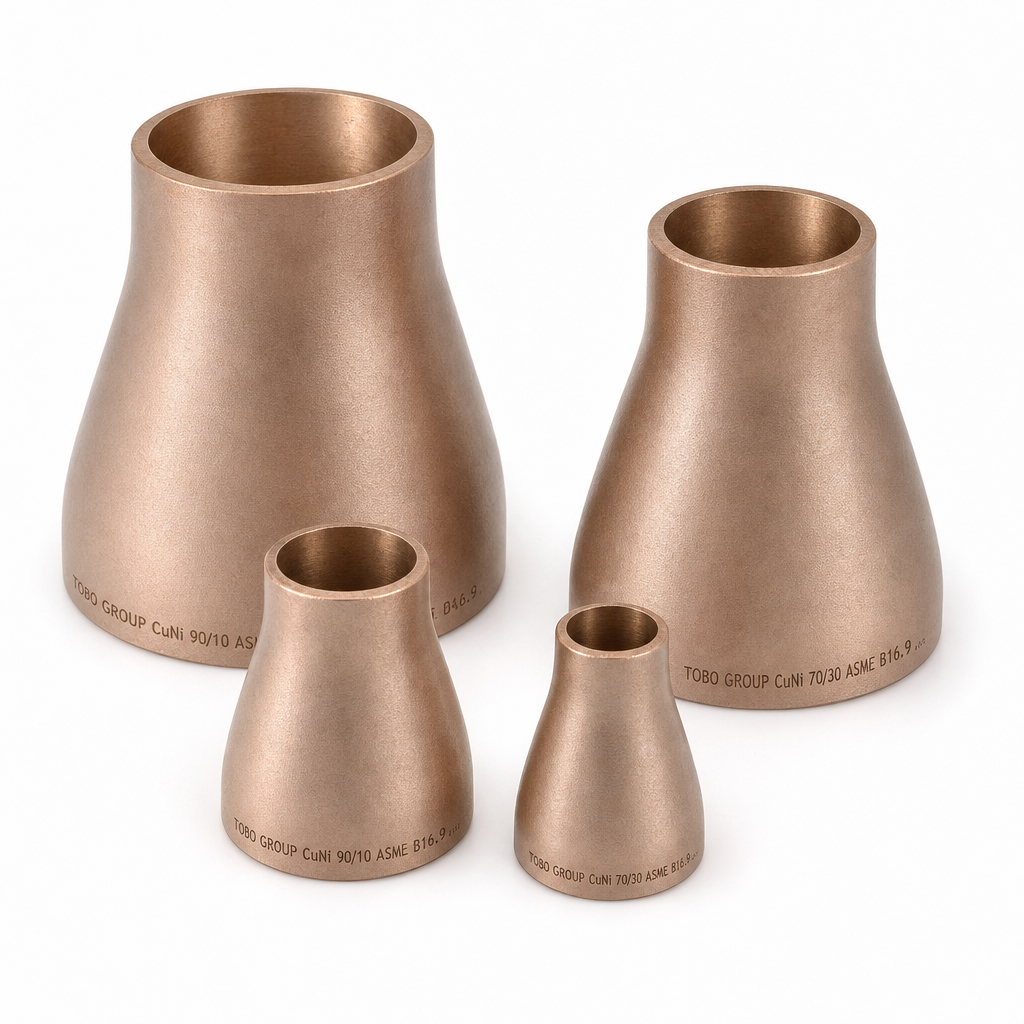
Core Industrial Advantages
1.Resistant to erosion and corrosion caused by flowing seawater; suitable for high-risk points in pipe-size transition zones
The nickel-rich iron corrosion product film formed on the surface of the copper-nickel alloy possesses dynamic self-healing capabilities in flowing seawater, effectively resisting erosion-corrosion and wall thinning caused by localized increases in flow velocity at sudden changes in pipe cross-section.
2.Naturally Resistant to Biofouling, Maintaining a Stable Flow Cross-Section
The slow release of copper ions provides a natural inhibitory effect against marine biofouling on the material’s surface, eliminating the need for external antifouling coatings. This helps prevent localized blockages and flow rate reduction in reducer sections of seawater pipelines caused by marine biofouling.
3.Metallurgical compatibility of butt-welded joints reduces the risk of galvanic corrosion
Copper-nickel reducers are typically connected to copper-nickel piping via butt welding. Since the weld seam shares the same corrosion resistance as the base material, this prevents galvanic corrosion issues caused by dissimilar metal welding in seawater environments, thereby enhancing the overall reliability of the piping system.
4.Concentric/Eccentric Structures Available to Accommodate Complex Piping Layouts
Concentric reducers are suitable for vertical piping or axially symmetric contraction applications; eccentric reducers are suitable for horizontal piping where the pipe bottoms must remain flush, helping to prevent gas accumulation or solid sedimentation and meeting diverse design layout requirements.
5.Dual-grade coverage (90/10 and 70/30) provides clear boundaries for engineering selection
The 90/10 grade balances corrosion resistance, strength, and life-cycle costs, making it suitable for conventional seawater cooling and ballast systems; the 70/30 grade offers superior resistance to high-velocity seawater erosion and is suitable for high-velocity, severe operating conditions such as pump outlets, areas near valve assemblies, and high-pressure seawater systems.
6.Comprehensive coverage of international standards facilitates access to global projects and product selection
The products comply with major standards such as ASTM B366/ASME B16.9, EEMUA 146, and DIN 86089, with sizes ranging from DN15 to DN1200 and wall thicknesses from SCH 5S to SCH XXS, allowing for direct selection in accordance with international specifications for shipbuilding, offshore engineering, desalination, power plants, and offshore oil and gas projects.
7.Significant life-cycle cost advantages reduce O&M burdens
In seawater and corrosive media containing chlorine or H₂S, copper-nickel alloy reducers rely on the material’s inherent corrosion resistance and stable service performance to reduce replacement and maintenance frequency, thereby lowering the O&M costs of piping systems from a full life-cycle perspective.
|
Parameter |
Specification |
|
Material Family |
Copper-Nickel Alloy (Cupronickel), wrought / seamless or welded construction |
|
Grade 90/10 |
UNS C70600 (CuNi10Fe1.6Mn; DIN 2.0872 / BFe10-1-1) |
|
Grade 70/30 |
UNS C71500 (CuNi30Mn1Fe; DIN 2.0882 / B30) |
|
Fitting Form |
Concentric Reducer (common centerline) / Eccentric Reducer (offset centerline for drainage or flush-bottom alignment) |
|
End Connection |
Butt Weld (BW) as standard; socket weld, threaded (NPT/BSP), and flanged configurations available on request |
|
Category |
Applicable Standard |
|
Dimensional |
ASME B16.9 (Factory-Made Wrought Buttwelding Fittings); DIN 86089 (metric CuNi reducer series); EEMUA 146 / 234 where specified |
|
Material — Fittings |
ASTM B466 (Seamless Copper-Nickel Pipe and Tube, applicable to fitting manufacture); ASTM B122 (Plate, Sheet, Strip, Rolled Bar) |
|
Material — Pipe/Tube Reference |
ASTM B111 (Condenser Tube), ASTM B467 (Welded Pipe) where cross-reference is required |
|
Pressure / Temperature Basis |
Rating is not fixed by the reducer alone; determined by the mating pipe schedule, design code, and end-connection class. Class 150 / 300 / 600 flanged ends and PN16 / PN25 ratings are commercially available |
Operational note: ASME B16.9 governs dimensions — end-to-end length, outside diameter at weld ends, concentricity / eccentricity tolerances, and weld-end geometry — not a standalone pressure rating. The pressure capability of a BW reducer is therefore inherited from the matching pipe wall thickness and design code, not stamped as a discrete "class" on the fitting itself.
|
Parameter |
Specification |
|
Nominal Size Range |
DN15 – DN1200 (½″ – 48″); commercially concentrated in DN20 – DN500 (¾″ – 20″) for standard marine / desalination spools |
|
Wall Thickness / Schedule |
Supplied to match mating pipe: SCH 40 / STD / 80 / XS / 160 / XXS or specified nominal wall |
|
End-to-End Length (H) |
Per ASME B16.9: fixed by the larger end size; concentric and eccentric reducers share the same H dimension for a given large-end NPS, allowing direct spool-length interchangeability |
|
Concentricity / Eccentricity Tolerance |
±0.8 mm (NPS ≤ 4 / DN100); ±1.6 mm (NPS > 4 / DN100) per ASME B16.9 tolerance tables |
|
Manufacturing Route |
Seamless (preferred for higher pressure / smaller sizes); welded (economical for large-diameter transitions) |
|
Element |
90/10 — UNS C70600 |
70/30 — UNS C71500 |
|
Ni |
9.0 – 11.0 |
29.0 – 33.0 |
|
Fe |
1.0 – 1.8 |
0.4 – 1.0 |
|
Mn |
≤ 1.0 |
0.5 – 1.5 |
|
Cu |
Balance |
Balance |
Composition ranges are consistent with ASTM B122 / B466 for the respective UNS designations.-23
|
Property |
90/10 — C70600 |
70/30 — C71500 |
|
Ultimate Tensile Strength |
275 – 415 MPa (40 – 60 ksi) |
345 – 515 MPa (50 – 75 ksi) |
|
0.2% Yield Strength |
105 – 345 MPa (15 – 50 ksi) |
125 – 415 MPa (18 – 60 ksi) |
|
Elongation at Break |
20 – 40% |
25 – 45% |
|
Hardness (Brinell) |
69 – 130 HB |
80 – 150 HB |
Values reflect commercially available tempers; exact mechanical properties are confirmed on the mill test certificate (MTC) for the supplied heat.
|
Parameter |
90/10 — C70600 |
70/30 — C71500 |
|
Max. Recommended Seawater Flow Velocity |
3.0 – 3.5 m/s |
3.5 – 4.0 m/s |
|
Typical Service Temperature Envelope |
≤ 100 °C (condenser / firewater / hull piping) |
≤ 200 °C (hot brine, higher-pressure service) |
|
Relative Corrosion / Erosion Resistance |
Excellent in clean seawater; adequate for standard cooling and firemain duty |
Superior resistance to impingement attack and erosion–corrosion in high-velocity or heavily aerated seawater |
|
Biofouling Resistance |
Good — copper-ion release suppresses marine organism settlement |
Good — same mechanism, with higher mechanical durability |
|
Relative Material Cost |
Baseline |
Approximately 30–50% higher per kg than 90/10 |
|
Typical Selection Logic |
Default for firewater mains, cooling-water mains at ≤ ~2.5 m/s, hull piping, general marine service-23 |
Specified where flow velocity exceeds 3.5 m/s, brine concentration is high, or higher-pressure / higher-temperature service justifies the premium |
Critical specification point: 90/10 and 70/30 are not interchangeable simply by "upgrading to the more expensive grade." The 10% vs. 30% nickel content changes the allowable velocity, impingement resistance, and temperature envelope. Specification should be driven by the actual flow velocity, salinity, temperature, and pressure class of the line.-23
|
Configuration |
Commercial Rating Basis |
|
Butt Weld (BW) |
No discrete class; pressure capability governed by mating pipe schedule and design code (e.g., ASME B31.3 / B31.1) |
|
Flanged Ends |
Class 150 / 300 / 600 (standard); higher classes available on request |
|
Metric / PN Basis |
PN16 / PN25 commonly offered for DIN / EEMUA-aligned projects |
Pressure–temperature derating shall follow the applicable code for the selected wall thickness and end connection; the reducer itself does not carry a standalone ASME B16.9 pressure class marking.
|
Sector |
Representative Services |
|
Marine & Offshore |
Seawater cooling, fire mains, ballast water, bilge, process water on vessels and offshore platforms |
|
Desalination & Water Treatment |
Intake piping, RO pre-treatment, brine discharge, circulating water |
|
Power Generation |
Circulating cooling water, condenser auxiliary cooling, coastal thermal and nuclear station water networks |
|
Petrochemical & Chemical |
Heat-exchanger interconnections, caustic transfer, cooling circuits, organic heat-transfer fluid lines |
|
General Industry |
Compressed-air, cooling-water, and process-material diameter transitions where corrosion resistance and biofouling resistance are required |
Applications are drawn from commercial CuNi reducer product literature covering both grades.-3
|
Item |
Standard Offer |
|
Mill Test Certificate |
EN 10204 3.1 — heat number traceable to UNS designation and mechanical results |
|
Surface Condition |
Pickled / passivated, or as-rolled; smooth internal bore free of scale or weld spatter |
|
Marking |
UNS number, size (large end × small end), wall thickness / schedule, standard (ASME B16.9), heat number |
|
Non-Destructive Testing |
Dye penetrant or radiographic examination on weld seams where specified (welded construction) |
|
Packaging |
Sea-worthy protection: end caps, VCI / desiccant where required, bundle-marked by spool reference |
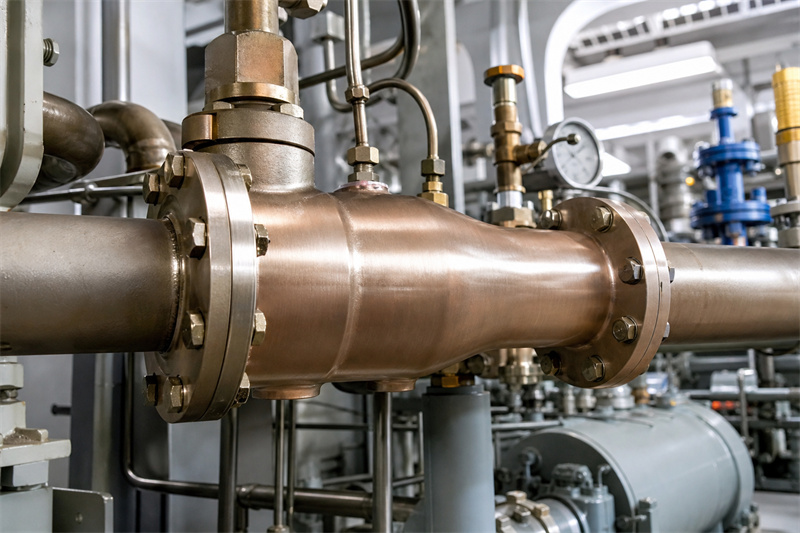
Shipbuilding and Ocean Engineering
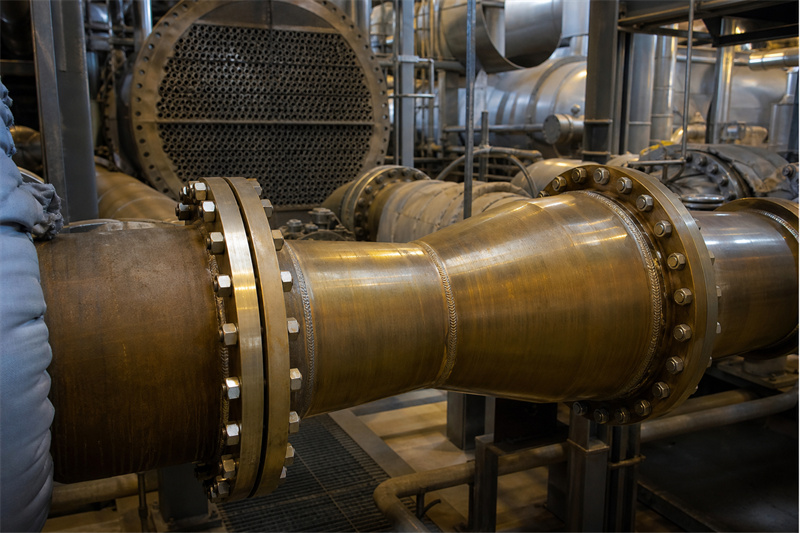
Electric Power and Energy Industry
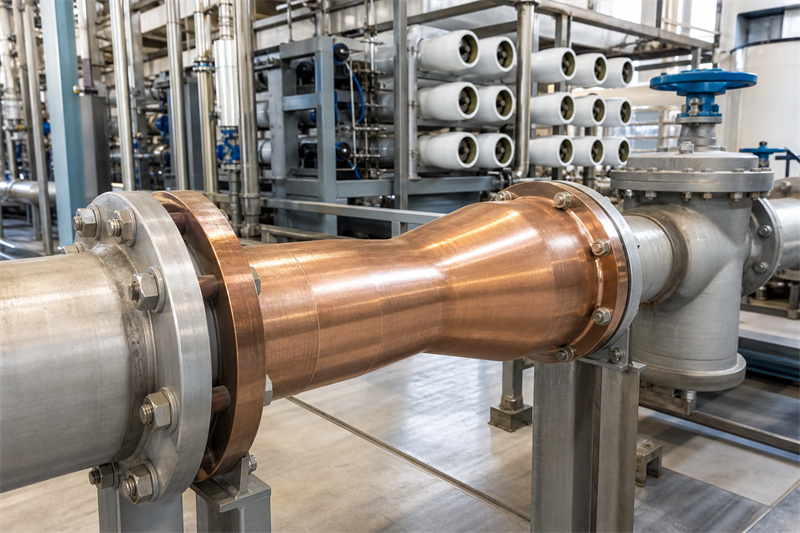
Seawater Desalination and Water Treatment
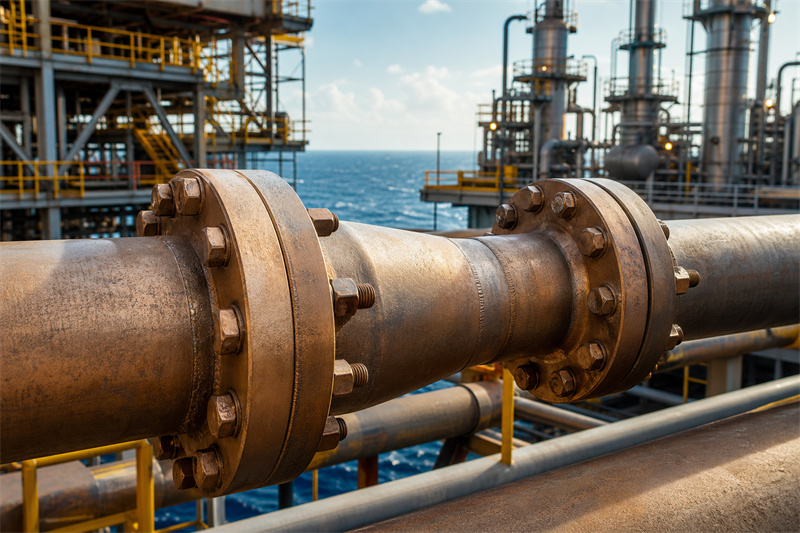
Petrochemicals and Process Industries

We provide full-lifecycle technical support covering material selection, welding, installation, and maintenance, including corrosion analysis, welding process recommendations, and design optimization consulting, to help customers mitigate project risks.

We support on-demand customization of outer diameter, wall thickness, length, and surface treatment. We offer a full range of processing services, including bending, U-bends, coiling, cutting, and welding, to meet both cut-to-length retail and bulk purchase needs.
Each batch is accompanied by a complete Material Test Certificate (MTC), ensuring full traceability throughout the process. We comply with international standards such as ASTM B111 and ASME SB111, and support classification society certification and third-party testing.

We maintain a stock of standard specifications in our domestic and international warehouses and implement a proactive inventory preparation mechanism to effectively shorten delivery lead times and ensure rapid response to urgent orders.

We provide technical installation guidance and rapid after-sales response. For product quality issues, we are responsible for returns, replacements, or compensation in accordance with the contract. Some suppliers also offer supplementary support such as sample tubes and engineering consulting.

Copyright © TOBO GROUP All Rights Reserved - Privacy Policy

 EN
 AR
 BG
 HR
 CS
 DA
 NL
 FI
 FR
 DE
 EL
 HI
 IT
 JA
 KO
 NO
 PL
 PT
 RO
 RU
 ES
 SV
 TL
 VI
 TH
 TR
 GA
 CY
 BE
 IS